Parking Lot Striping in Glendale, CA

ADA-compliant layouts, fire lane marking and pavement markings for commercial property, scheduled around your tenants.

Get Your Free Quote

Fast response • No obligation

So we can reach you about your request.

So we can send you a confirmation after you submit this inquiry form.

  • 20+ Years Striping Commercial Lots
  • ADA Layouts Checked to Chapter 11B
  • Night & Weekend Scheduling

What we do

Our Services

Commercial parking lot striping across Glendale, CA

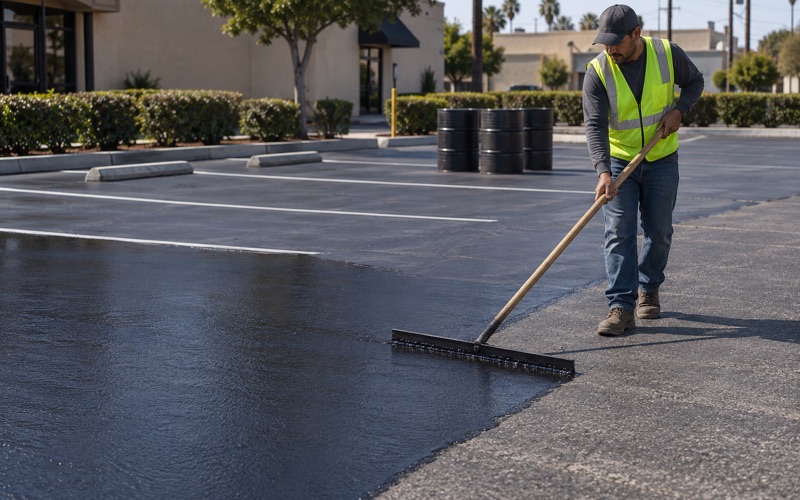
Worker drawing a squeegee across a commercial lot, the wet black sealer edge running hard against unsealed gray asphalt with a wheel stop at the boundary.

Sealcoating in Glendale, CA

Commercial lot sealcoating in Glendale, CA, with honest surface reporting and striping restored the same visit.

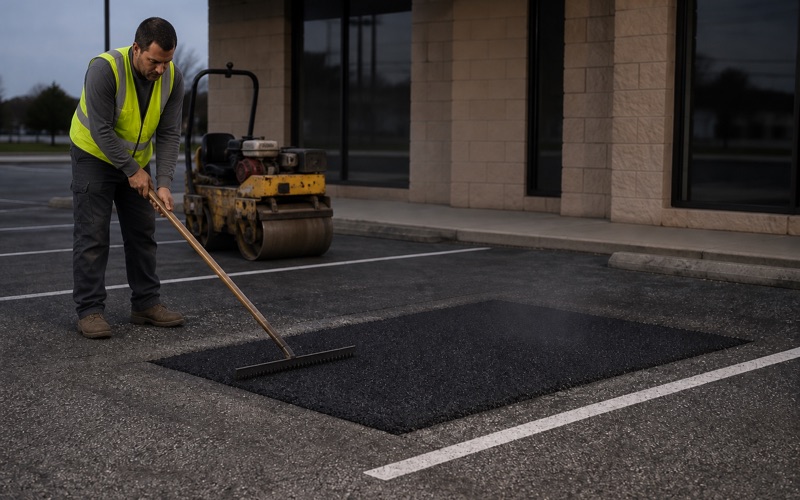
Worker raking hot mix into a saw-cut patch in a parking lot, the cut edges square against sound asphalt and a walk-behind roller waiting alongside.

Asphalt Repair in Glendale, CA

Commercial asphalt repair in Glendale, CA, diagnosed honestly and striped back the same visit.

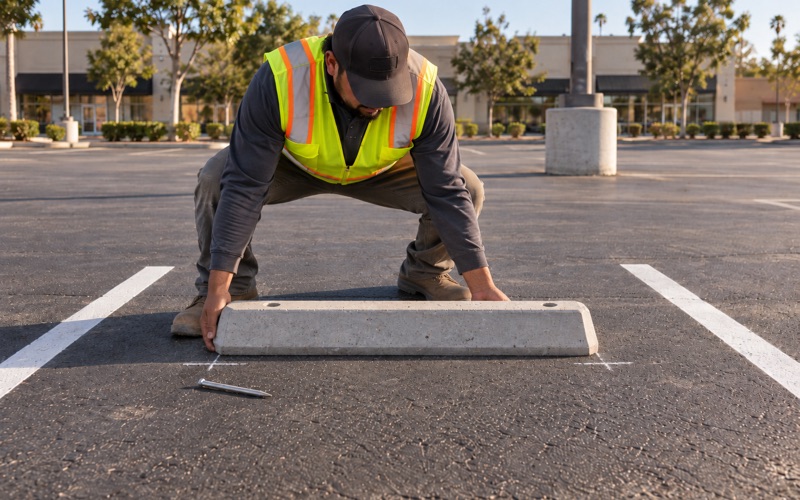
Worker lowering a precast concrete wheel stop onto its marked position at a stall head, the drilled anchor hole and steel spike ready beside it.

Speed Bumps and Wheel Stops in Glendale, CA

Speed bumps, humps and wheel stops installed and marked across commercial property in Glendale, CA.

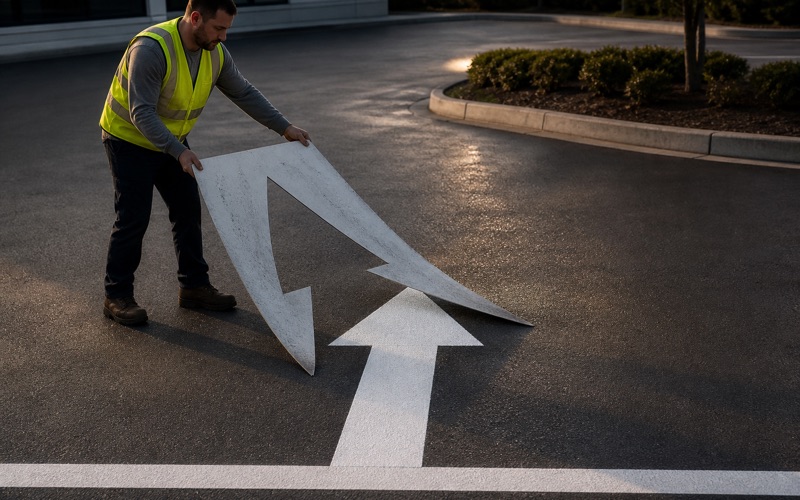
Worker lifting a large sheet stencil clear of a freshly painted white directional arrow, the arrow pointing away toward the drive aisle it serves.

Pavement Markings in Glendale, CA

Arrows, legends, crosswalks and custom stencils marked to California MUTCD specification across Glendale, CA.

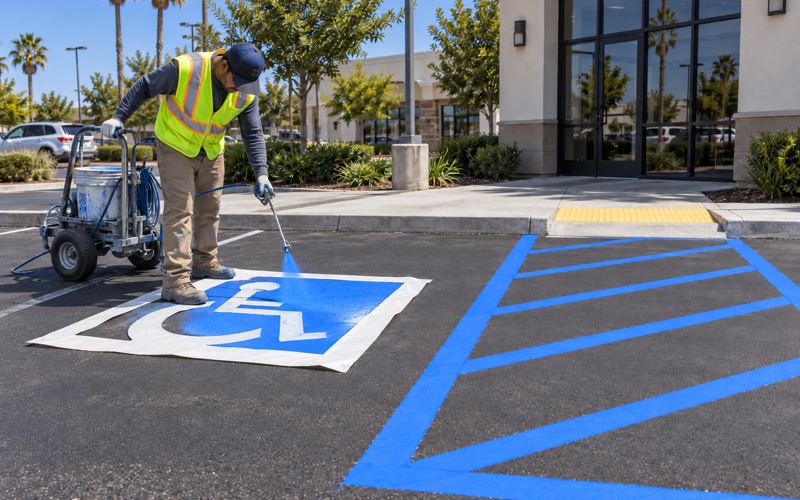
Worker spraying the blue field of an accessible stall symbol, the hatched access aisle already marked alongside and running to a curb ramp.

ADA Parking Striping in Glendale, CA

Accessible stall striping, access aisles, symbols and signage laid to California Chapter 11B in Glendale, CA.

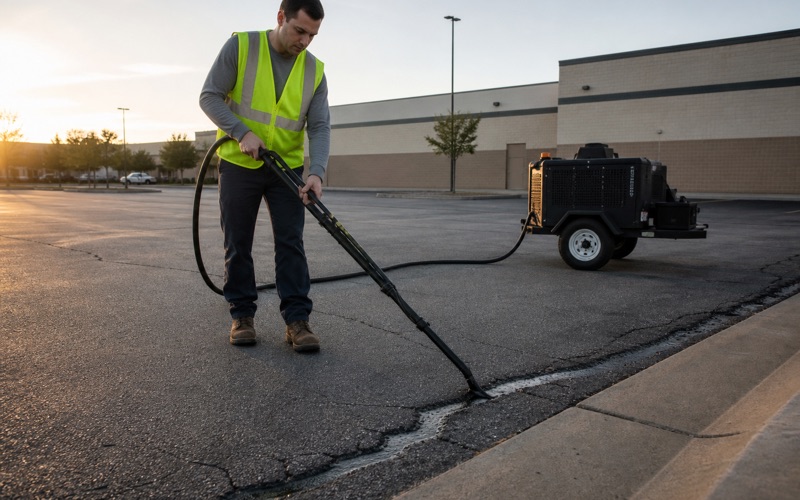
Worker tracking a hot-pour sealant wand along a routed crack across a parking lot, the hose trailing back to the melter behind him.

Crack Sealing in Glendale, CA

Hot-applied crack sealing for commercial lots in Glendale, CA, specified for a hot dry climate.

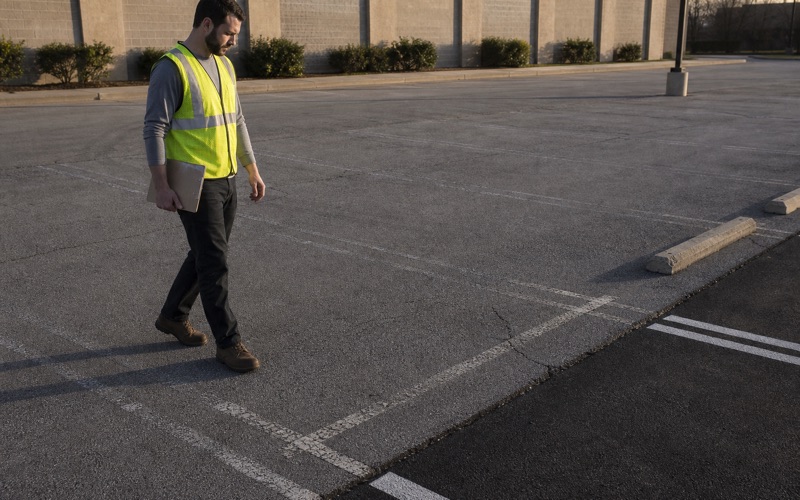
Contractor walking a lot at low sun on an inspection round, clipboard held closed against his side and faded stall lines running away to a curb.

Parking Lot Maintenance in Glendale, CA

Scheduled parking lot maintenance for commercial property in Glendale, CA, with written intervals and documented reports.

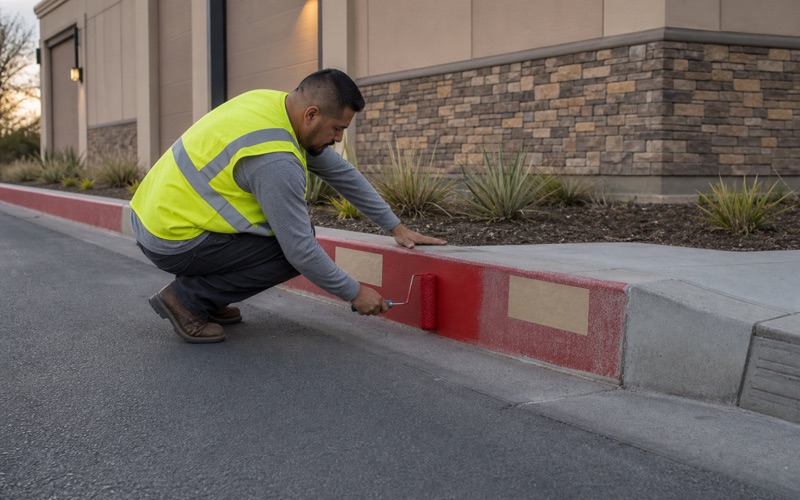
Worker repainting a fire lane CURB red along a commercial frontage, the masked lettering panels left blank and the driving surface unpainted.

Fire Lane Striping in Glendale, CA

Fire lane marking and red curb painting for commercial property in Glendale, CA, confirmed with the local AHJ.

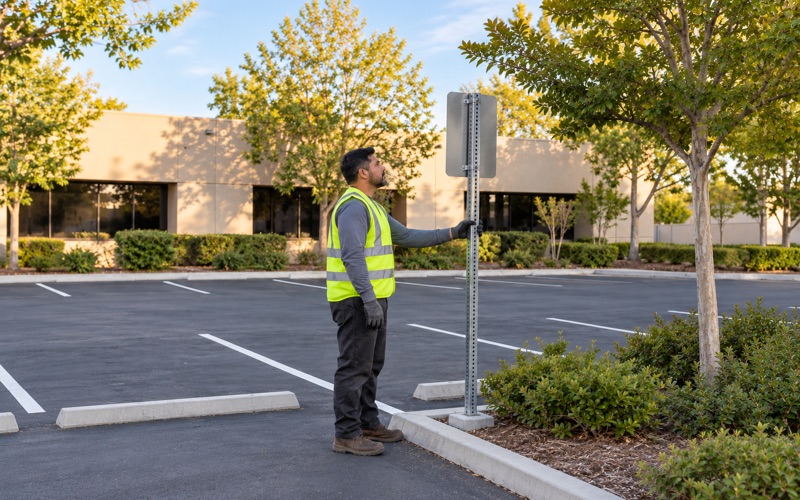
Worker holding a sign post plumb in its footing at the head of a stall, the sign face turned oblique to the camera and the stall marked below it.

Parking Lot Signage in Glendale, CA

Accessible stall signs, tow-away notices, bollards and posts supplied and installed across Glendale, CA.

Operator walking a line striper down a warehouse aisle, the fresh yellow aisle line running back between pallet racking to a painted column base.

Warehouse Floor Striping in Glendale, CA

Interior aisle marking, walkways and hazard zones for warehouses and plants across Glendale, CA.

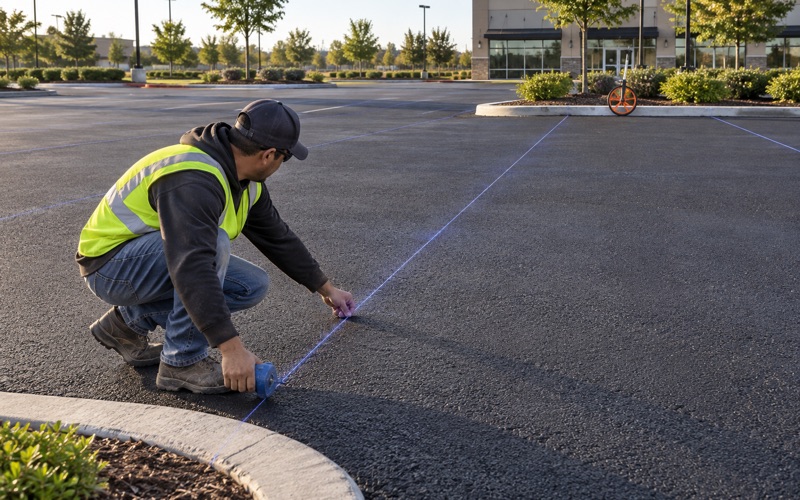
Worker snapping a chalk line across bare asphalt to set out a new stall run, the blue chalk marks running back to a curb with no paint laid yet.

Parking Lot Layout and Design in Glendale, CA

Parking lot layout and stall-count design for commercial property in Glendale, CA, approved before painting.

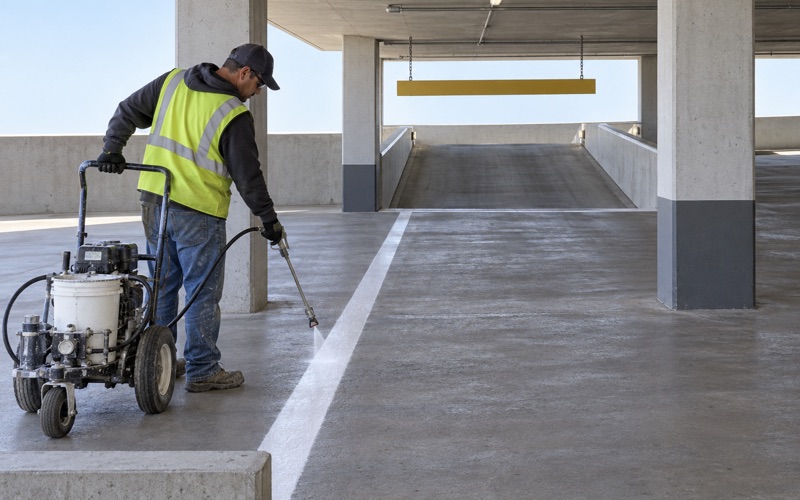
Worker spraying a stall line on an above-grade parking deck, the line running back between painted columns toward the head of a down ramp.

Parking Garage Striping in Glendale, CA

Striping and marking for parking structures and decks across Glendale, CA, worked under low clearance.

What Stands Behind the Work

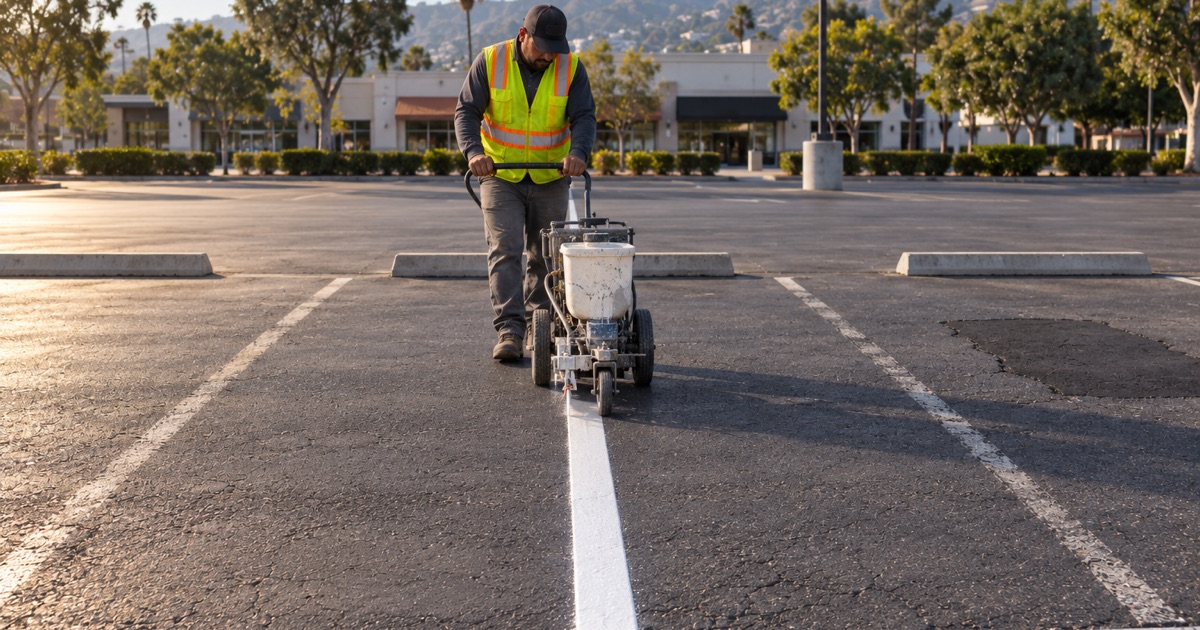
Striping contractor walking a walk-behind line striper down a Glendale commercial lot, the fresh white stall line running back from the machine to a wheel stop at the row’s end.

Twenty Years of Commercial Lot Work

We have spent more than twenty years striping commercial property, which in practice means we have re-striped the same shopping centers, business parks and industrial yards through several cycles of wear. That history is why our proposals name a re-stripe interval instead of leaving the next round to a complaint, and why we can tell a property manager what a lot will look like in eighteen months rather than only what it looks like on the day we leave.

Why Choose Glendale Parking Lot Striping

Layout Approved First

Every job starts with a drawn layout that you approve before a single line is laid, so a disputed stall count is settled on paper rather than argued over a finished lot, rather than the common approach of painting first and discovering afterward that the accessible route no longer reaches the door.

Code Checked Every Visit

No lot leaves us without its accessible stalls, access aisles and signage checked against current California requirements, because CBC Section 11B-108 makes maintaining those features an obligation in its own right, so a faded symbol is caught during ordinary work rather than by someone holding a demand letter.

Built for a Regulated Air Basin

All of our marking work is specified for the South Coast air basin, where SCAQMD Rule 1113 caps traffic coatings at 100 g/L of volatile organic compounds, so what we apply is legal to apply here rather than a product chosen from a national catalog that would put both of us on the wrong side of the rule.

Your Lot Stays Open

We section the work and schedule it at night and on weekends, because a retail center in Glendale cannot surrender its parking at noon on a Saturday, so tenants keep trading through the job rather than losing a day to a closed property.

Old Lines Removed, Not Buried

Every changed layout gets its previous markings removed rather than blacked out, so a new plan does not leave ghost lines showing through under low winter sun, rather than the shortcut that looks clean for a month and confuses drivers for years.

One Crew, One Mobilization

Striping, signage, wheel stops and bollards are all handled by the same crew on the same visit, so a property does not pay three vendors to mobilize three times for work that belongs on one schedule.

Getting the Lot ADA Compliant Before It Costs You

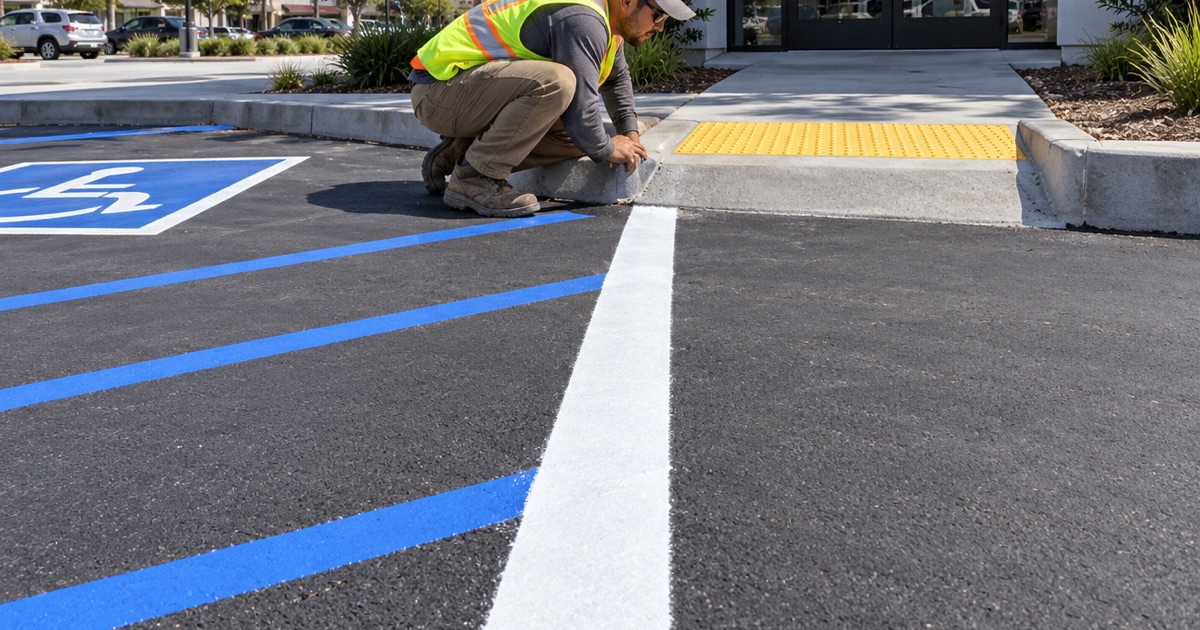
Worker crouched at a curb ramp with both hands on its concrete nosing, sighting back along the white route bar that runs to the accessible stalls behind him.

The Fifteen-Day Correction Window

California Civil Code Section 55.56(e)(1)(F) treats faded, chipped or deteriorated paint in parking spaces and access aisles as a presumed-harmless technical violation when it is corrected within fifteen days. We prioritize scheduling for property owners working inside that window, because the difference between a corrected lot and an uncorrected one is the difference between a paperwork problem and a damages claim. It is the single strongest reason not to let striping drift.

Parking Leads the Complaint Tallies

The California Commission on Disability Access publishes what claimants actually allege, and parking sits at the top of that list by a wide margin, with several of the ten most common categories describing the parking area alone. We treat a lot’s accessible stalls as its highest-exposure square footage rather than as a detail at the edge of the job. That ranking is why an inspection here starts at the accessible route and works outward.

Federal Sets the Count, California Sets the Geometry

The number of accessible stalls a lot owes is a federal question, and Table 11B-208.2 of the California Building Code matches the federal table in the 2010 ADA Standards for Accessible Design exactly. Where California departs is in how each of those stalls must be sized, marked and signed. We work to the California figures throughout, because meeting the federal standard alone leaves a compliant count of non-compliant stalls.

Where California Stall Dimensions Exceed the Federal Standard

Section 11B-502 requires a wider car stall than Section 502 of the federal standard, sets a minimum stall length the federal standard does not specify at all, and requires a wider van stall. California also requires the van access aisle on the passenger side of every van space rather than only angled ones. We build layouts to these dimensions from the start, because retrofitting width into a finished lot usually costs stalls.

The Pavement Symbol and the Aisle Beside It

California requires the International Symbol of Accessibility painted on the surface of each accessible stall at thirty-six inches square, which the federal standard does not require at all, along with an access aisle bordered in blue. We lay both to the Caltrans standard plan details rather than freehand, because a symbol drawn at the wrong proportion reads as a defect to an inspector and to a claimant alike.

Aisle Lettering and the Fine Amount on the Sign

The access aisle carries NO PARKING in white letters at least twelve inches high, and the stall sign carries the accessibility symbol in white on blue, reflectorized, above the minimum fine language the state specifies. We supply and set those signs as part of the striping visit. A correctly marked stall with a missing or unreadable sign is still a finding.

What a CASp Inspection Gives You

A Certified Access Specialist inspection is a separate service from ours, carried out by a state-certified inspector, and it produces a report that carries specific procedural protections if a construction-related accessibility claim is later filed. We work from CASp reports where a client already has one and we tell owners plainly when getting one is worth it. We do not perform the inspection ourselves, and any contractor who says they can is describing something else.

Maintenance Is Its Own Obligation

Section 11B-108 of the California Building Code requires accessible features to be maintained, which means a symbol that has weathered to a pale outline is a live code issue rather than only a litigation risk. We inspect and report on that condition during any visit to a property. It is the clause that turns striping from a cosmetic budget line into a compliance one.

Striping, Markings and Everything Painted on the Surface

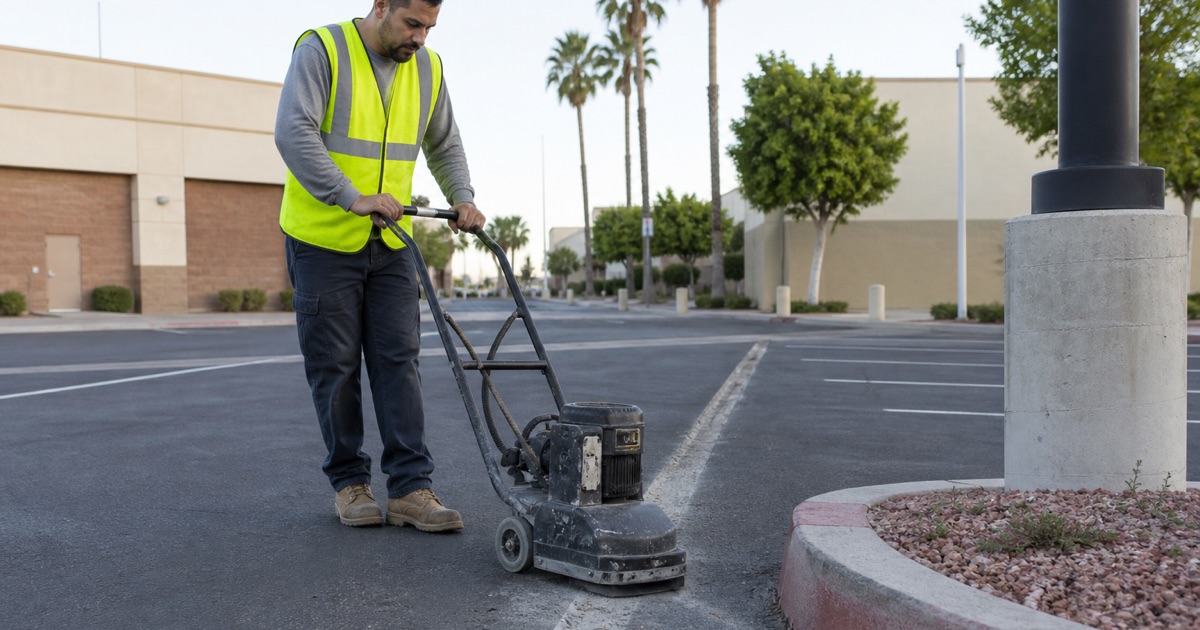
Worker running a walk-behind grinder along an obsolete stall line, the scarified scar it leaves running back toward a curb while the current layout stays untouched alongside.

Re-Striping Against a Fresh Layout

Putting the same lines back on an existing layout is a fundamentally different job from setting out a lot from scratch, and the two carry different prices, timelines and risks. A re-stripe follows what is already there and can often be done in a single night; a new layout requires drawing, approval and usually removal of the old plan first. We quote them separately so nobody discovers the difference halfway through.

Stall Angle and the Interlock That Decides Capacity

Layouts at 90 degrees, 60 degrees and 45 degrees each trade stall count against how easily a driver can enter and leave, and angled layouts recover space through the interlock where adjacent stalls overlap within a module. We model the options against your actual lot dimensions before recommending one. The difference between two workable angles on the same lot is frequently several stalls.

Stall Width as a Decision About Who Parks There

Stall width is not one number. A lot serving all-day employee or student parking tolerates a narrower stall than one serving a grocery anchor or a medical office where drivers arrive with carts, children and door swings. We set width against turnover and user rather than defaulting to whatever the previous contractor used.

Fire Lanes and What the Department Actually Enforces

California Fire Code Section 503.3 requires fire apparatus access roads to be marked, and the local fire department applies its own amendments to how that is done, which is why the specification changes between neighboring cities. We confirm the requirement with the authority having jurisdiction over your address before marking. Vehicle Code Section 22500.1 is what makes the marking enforceable against a parked car.

Curb Colors Are Statutory, Not Decorative

California Vehicle Code Section 21458 assigns meanings to red, yellow, white, green and blue curbs, so painting a curb is a statement about what the law permits there. We paint curbs to those meanings and tell owners when the color they have asked for would misstate the restriction. A wrongly colored curb is unenforceable at best and misleading at worst.

Crosswalk Patterns and the Names the Code Uses

The California MUTCD names crosswalk patterns in Chapter 3C as transverse, ladder and bar pair, which are not the words the trade uses in conversation. We specify them by the code names on drawings so that what gets installed matches what an inspector expects to see. Decorative treatments are permitted only in subdued color between the prescribed lines.

Arrows, Legends, Stencils and Branded Markings

Directional arrows, word legends and symbols are governed by Chapter 3B of the California MUTCD, and words, symbols and arrows are required to be white. Custom and branded markings are genuinely open to design, and we produce those alongside the regulated ones. Knowing which category a marking falls into is most of the job.

EV, Rideshare and Curbside Pickup Stalls

Electric vehicle stalls carry a required white EV CHARGING ONLY legend, while the green pavement most people picture is industry convention rather than a requirement, and federal guidance actually discourages it. Rideshare, curbside pickup and expectant-mother stalls are unregulated in their symbols and free to design. We mark the prescribed parts to specification and treat the rest as branding.

Keeping the Asphalt Under the Paint Alive

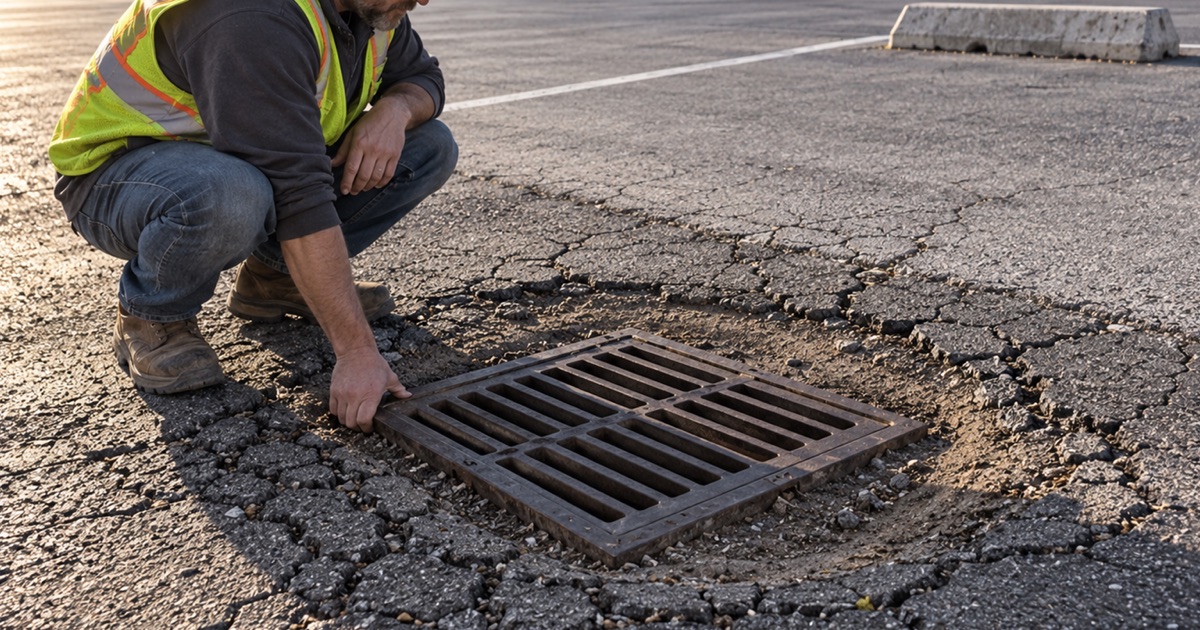
Worker crouched at a lot’s catch basin with one hand on the grate frame, alligator cracking spreading from the low point into sound asphalt beyond.

Sealcoating a Commercial Lot

Sealcoating a commercial parking lot is a different job from sealing a residential driveway, in scale, in equipment and in the coating itself, which SCAQMD regulates as a separate category with its own limit. We do commercial lots only. A crew and a product sized for a driveway will not produce a uniform finish across an acre of traffic-worn asphalt.

Crack Sealing and the Right Sealant Class

Hot-applied crack sealants are classified by the climate they are formulated for under ASTM D6690, and the moderate-climate class is the correct one here. Cold-climate grades stay soft in summer heat and track under tires, and at least one manufacturer states plainly that its cold-weather product is not recommended for parking lots. We specify to the climate rather than to whatever is on the truck.

Patching, Overlay, or Neither

A lot with isolated failures needs patching, a lot with widespread surface distress over sound base needs an overlay, and a lot with base failure needs neither until the base is addressed. We report which of the three you actually have. Selling an overlay onto a failing base is the most expensive mistake available in this trade.

Why Paint Fades Faster Here

National guidance on re-stripe intervals is largely written against markets where wear comes from freeze-thaw cycling, road salt and plow blades, none of which exist here. In this basin the drivers are ultraviolet exposure and traffic volume, and paint chalks and washes out rather than being scraped away. We set intervals against local conditions, which run shorter than the figures most national sources quote.

Surface Preparation and the Oil Spots

Paint applied over dust, loose material or oil will not bond, and oil spots in particular reject coating and reappear through it within weeks. We clean, blow and treat contaminated areas before any paint is laid. Preparation is the part of the job a low bid removes first, and it is the part that decides how long the result lasts.

Removing Old Markings Instead of Burying Them

When a layout changes, the old lines have to come off. Painting black over them hides the problem for a season and then reappears as ghost lines under low sun and after rain, leaving drivers reading two layouts at once. We remove rather than cover, and we tell owners when a proposal that looks cheaper is doing the opposite.

Grinding, Water Blasting and the Methods Nobody Mentions

Marking removal is done by grinding, by high-pressure water blasting, by shot blasting, or chemically, and each leaves a different scar on the surface. Grinding is fast and leaves the most visible mark; water blasting is cleaner and slower. We choose by surface type and by how visible the scar will be under the new layout, and we explain the trade-off rather than presenting one method as the only one.

When Sealcoating Is the Wrong Purchase

Sealcoat protects sound asphalt from oxidation and water. It does not bridge structural cracking, it does not fix a failing base, and applied over either it buys appearance for a season while the underlying failure continues. We say so when that is the situation, even though the honest answer is the smaller invoice.

What It Costs, and Who Actually Pays for It

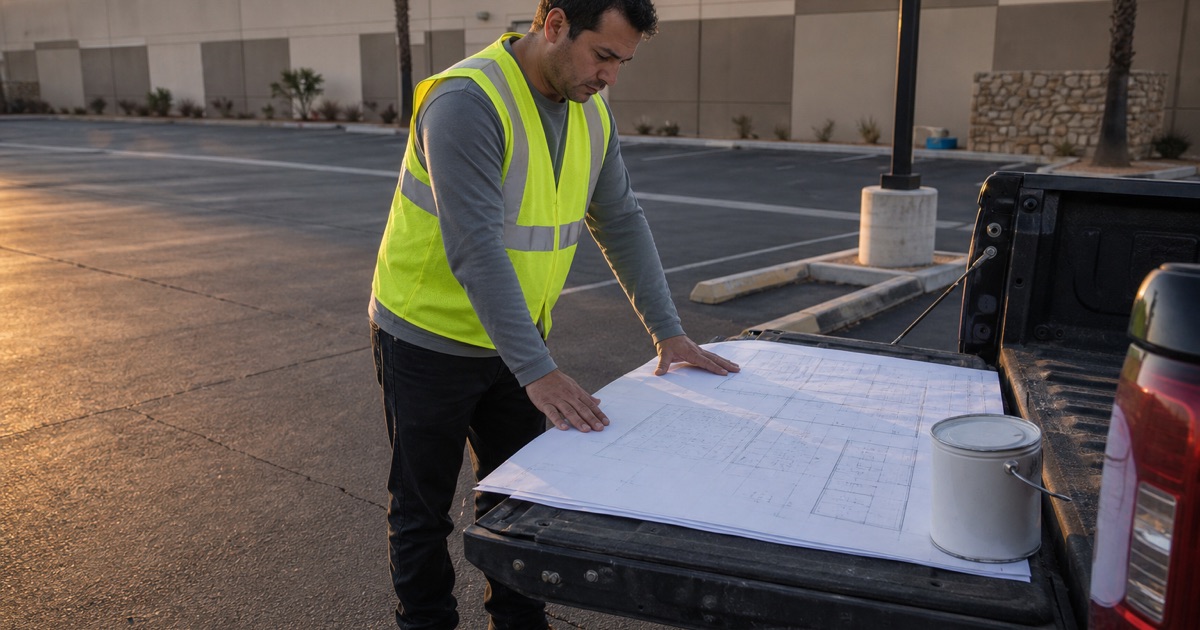
Marked-up parking layout drawing spread on a truck tailgate at the edge of a lot, the contractor’s hands flat on it and the unstriped asphalt behind.

How Striping Is Priced

Striping is normally priced by the stall for standard layouts, by the linear foot for continuous lines and curb work, and per item for stencils, arrows, signs and wheel stops, with a mobilization charge covering getting equipment and crew to the site. Accessible stalls price separately because they carry the symbol, the hatched aisle and the signage. We break quotes out this way so a property manager can see what changes if scope changes.

Why a New Layout Costs More

Laying out a lot from scratch carries drawing time, approval, removal of the previous markings and a slower application, none of which a straight re-stripe involves. The premium is real and it is worth knowing about before the decision is made. We price both when an owner is genuinely choosing between them.

Maintenance Against Capital

Repainting stripes is generally treated as maintenance, while repaving is generally a capital event, and the line between them is what decides how the cost is recorded and whether it can be recovered from tenants. We describe the work in our proposals precisely enough that your accountant can make that call. Vague scope language is what turns a routine invoice into a disputed one.

Recovering Lot Maintenance From Tenants

In most commercial leases, routine parking lot maintenance is a common area expense recovered from tenants pro rata, while capital improvements are typically excluded from that recovery. Which side of the line the work falls on therefore changes who ultimately pays for it. We provide documentation itemized well enough to support that reconciliation.

Responsibility Under a Triple-Net Lease

A triple-net lease does not automatically mean the tenant carries everything, and parking lot and structural items are among the most commonly carved out and left with the landlord. That carve-out is often why the property owner is the one calling us. We work with whoever holds the obligation and we do not offer opinions on the lease itself.

Budgeting the Cycle Instead of Waiting

Faded-line inspections come with a written re-stripe interval so the next cycle can be budgeted rather than triggered by a complaint, an inspection or a new tenant. Property managers on a scheduled cycle spend less over a decade than those reacting to events. For associations, reserve study cycles under the Davis-Stirling Act make pavement a scheduled line item already.

An Accessible Stall Against a Demand Letter

Bringing a non-compliant accessible stall into specification is a small, bounded cost. A construction-related accessibility claim is not, and California maintains its own procedural machinery around them, including attorney reporting duties under Civil Code Section 55.32 and a high-frequency litigant definition in Code of Civil Procedure Section 425.55. The arithmetic favors correction and it is rarely close. Government Code Section 4467 even funds local accessibility compliance grants some small businesses can draw on.

Night Work and Phasing

Working at night or across weekends, and phasing a lot in sections so part of it stays open, both cost more than closing a property and working straight through in daylight. For most retail and medical property that premium is smaller than a day of lost trading. We quote the phasing plan explicitly rather than burying it, so the choice is yours to make.

Areas We Serve

Glendale Parking Lot Striping provides parking lot striping throughout the greater Glendale area, with the same crews and the same standards on every job.

Good to know

Frequently Asked Questions

How long does a parking lot re-stripe take?

Most re-stripes of an existing layout are a single night's work for a typical retail or office lot, with the paint dry enough to open by morning. Laying out a lot from scratch takes longer because the old markings have to be removed and the new plan set out and checked before painting. Larger industrial properties and structured parking are phased across several nights so no part of the site closes for a full day.

How often should a commercial parking lot be re-striped?

It depends on traffic volume, sun exposure and the paint used, and in this region markings fade faster than national guidance suggests because the wear here comes from ultraviolet exposure rather than freeze-thaw cycling or plow damage. A high-turnover retail lot needs attention sooner than a low-traffic office lot. We give a written interval after inspecting the surface rather than quoting a general figure.

Do you work on occupied properties without closing them?

Yes, and it is how most of our work is done. We section the lot so part of it stays open and available throughout, and we schedule at night and on weekends for retail, medical and mixed-use property that cannot give up parking during trading hours. The phasing plan is written into the quote so you can see exactly which areas are affected and when.

What kind of paint do you use on parking lots?

Primarily waterborne traffic coatings that meet the volatile organic compound limit SCAQMD Rule 1113 sets for this air basin, with thermoplastic and higher-build materials specified where traffic volume or a client's durability requirement justifies them. Glass beads are added where retroreflectivity is wanted for low-light conditions. We name the product and the application in the quote, because a cheap re-stripe and a durable one look identical the day they are finished.

Can you tell me whether my lot meets accessibility requirements?

We check accessible stalls, access aisles, pavement symbols and signage against current California Building Code Chapter 11B requirements as part of any visit, and we report what we find in writing. That is not the same as a CASp inspection, which is performed by a state-certified access specialist and carries specific legal protections. Where a property needs that level of certainty we will say so rather than implying our report substitutes for it.

Why is California different from the federal ADA standard?

The number of accessible stalls required is the same under both, but California specifies larger stall dimensions, requires a thirty-six-inch accessibility symbol painted on the surface that federal law does not, and sets its own rules for access aisle marking and signage. A lot built only to the federal standard can have the right number of stalls and still fail here. We work to the California figures throughout.

Do you handle signs, wheel stops and bollards as well as painting?

Yes. The same crew installs parking signage, concrete and rubber wheel stops, bollards and speed bumps on the same visit as the striping. Splitting that work between separate vendors means paying for several mobilizations and coordinating schedules across contractors for work that belongs on one job.

What happens to the old lines when a layout changes?

They are removed, by grinding, water blasting, shot blasting or chemical means depending on the surface and how visible the scar will be. We do not black out old markings with dark paint, because that reappears as ghost lines under low sun and after rain and leaves drivers reading two layouts at once. Removal costs more up front and is the only approach that actually resolves the problem.

Do you do residential driveways?

No. We work on commercial, industrial, institutional and multi-family property only. Driveway sealing is a different job at a different scale, with different equipment and a separately regulated coating category, and a crew set up for parking lots is the wrong crew for it.

Will you tell me if my lot needs repair before striping?

Yes, including when that means a smaller job for us. Fresh paint over failing asphalt looks correct for a season and then fails with the surface underneath it, and sealcoat applied over structural cracking or a failing base does not bridge either. We report surface condition honestly and recommend the sequence that makes the money last, even when the honest recommendation is to spend less with us now.

Ready to Get Started?

Request a free quote today and we'll get back to you fast.