
Glendale Parking Lot Striping carries out commercial asphalt repair across Glendale, CA and the surrounding cities, including Van Nuys, North Hollywood, Alhambra, Highland Park and South Pasadena. Most of the repair work we do arrives as a striping inquiry, because a property manager notices the lines have gone and then notices what the lines were hiding.
Repair is the part of parking lot work where diagnosis matters more than execution. The same visible defect can mean a surface problem, a drainage problem or a base failure, and the three carry entirely different repairs at entirely different costs. Patching a base failure produces a patch that fails the same way within a year, which is why we report what is actually wrong before quoting what to do about it.
Because the same crew handles repair, sealing and striping, a lot does not need three vendors and three mobilizations to come back into service. The layout goes back down as soon as the surface is ready, and accessible stalls are checked against current requirements while the asphalt is fresh rather than after everything is marked.
Reading What the Damage Means
Surface Distress Against Base Failure
Raveling, oxidation and hairline cracking are surface conditions on otherwise sound pavement, and they are addressed with crack sealing and a coating. Alligator cracking, rutting and pavement that flexes underfoot indicate the base beneath has lost bearing capacity, and no surface treatment repairs that. Telling them apart on site is the difference between a repair that lasts a decade and one that fails within a season.
Potholes Are a Symptom, Not the Condition
A pothole forms where water has entered through a crack or joint, weakened the base and let traffic punch through. Filling the hole without addressing how water reached the base produces a repair that reopens at the same spot. We look for the entry path and the drainage pattern before deciding whether a patch is genuinely the answer.
Ponding Tells You About the Grade
Standing water after rain marks a low spot where the surface no longer drains, and it accelerates every other failure mode because water sitting on asphalt works its way in. Correcting it means addressing grade rather than resurfacing, which is a larger conversation and an honest one to have early rather than after a patch has failed twice.
The Repairs Themselves
Saw-Cut Patching
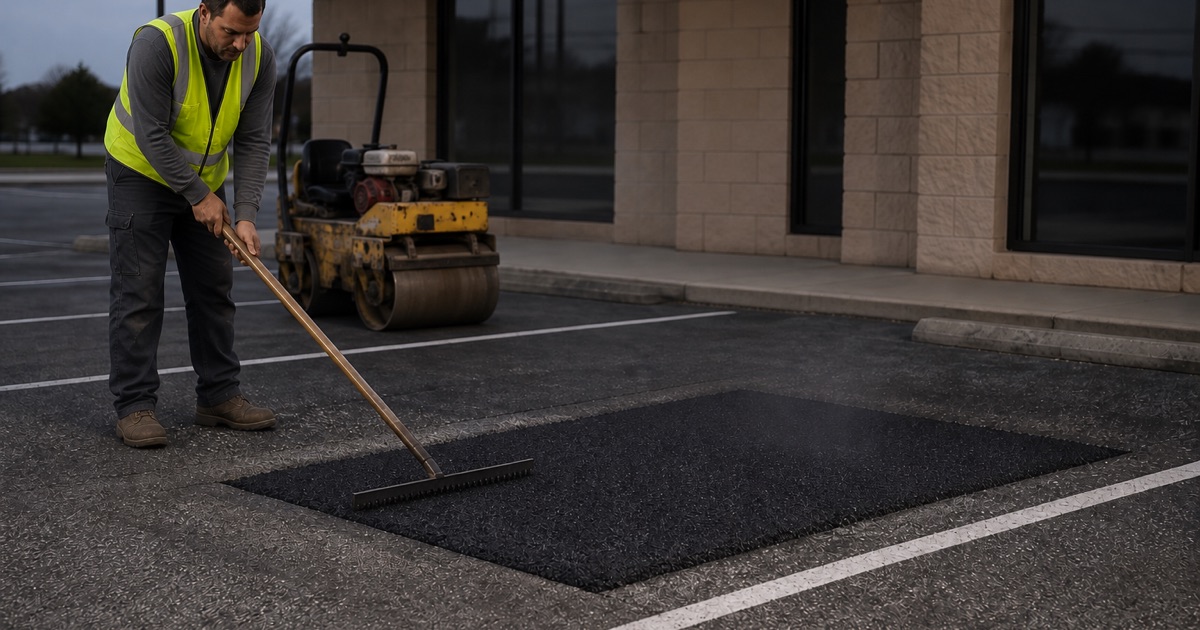
For isolated failures, the sound approach is to saw-cut a clean rectangle beyond the damaged area, excavate to sound material, address the base if it has failed, then place and compact hot mix in lifts. Cutting square edges and compacting properly is what keeps the patch from unravelling at its perimeter. Throw-and-go cold patch has a place as a temporary safety measure and almost none as a repair.
Full-Depth Repair Where the Base Has Gone
Where the base itself has failed, the repair goes down through it: excavate, replace and compact the aggregate base, then rebuild the asphalt above. It costs more per square foot than a surface patch and it is the only thing that actually resolves the failure. We quote it as what it is rather than disguising the cost by proposing something that will not hold.
Overlay, and When It Is the Wrong Answer
An overlay resurfaces a lot with a new asphalt layer and suits pavement with widespread surface distress over a sound base. Laid over a failing base or over unaddressed cracking, it reflects those cracks back through within a couple of years. We recommend an overlay only when the base supports it, and we say so plainly when reconstruction is the honest answer.
Sequencing, Access and Putting the Lot Back
Repair Comes Before Sealing and Striping
The order is not negotiable: repair, then seal, then stripe. Fresh markings laid over asphalt that is about to be cut open are markings paid for twice, and this is the single most common sequencing error we are called in to correct. Where budget forces the work across two fiscal years, we will say which parts to do now so the money is not wasted.
Keeping the Property Trading
Repair work is noisier and more disruptive than striping and needs more of the lot for longer, so phasing matters more. We section the work so part of the property stays open, and we schedule at night or across weekends for retail, medical and mixed-use sites. The phasing plan is written into the quote rather than negotiated on the day.
Markings and Accessible Stalls Go Back Correctly
Any repair that touches an accessible stall, its access aisle or the route between the stall and the building is an opportunity to bring that area up to current California requirements while the surface is blank. We check accessible stalls, aisles and signage as a matter of course on every visit, not only when a client asks, and we report what we find in writing.
Deciding What to Repair and When
Triage by Liability, Not by Appearance
The defects that look worst are rarely the ones that matter most. A wide crack across an empty corner of the lot is cosmetic; a two-inch drop at the head of an accessible route is a claim waiting to be filed. We rank findings by exposure first and appearance second, so a constrained budget goes to the things that carry real risk.
Trip hazards on pedestrian routes, failures inside accessible stalls and access aisles, and anything obstructing a fire apparatus access route come before general surface condition every time. Those are the defects that turn into an injury claim or an access complaint rather than a maintenance line item. Everything else can usually wait for the cycle it belongs in.
Phasing Across Budget Years
Few properties can fund everything a survey turns up in one cycle, and that is normal rather than a problem. What matters is that the work is split so the first phase is not undone by the second: repairs before coating, coating before markings, and drainage before anything laid on top of it.
We will map that sequence across two or three budget years and tell you plainly which items can wait and which will cost more the longer they are left. Water reaching the base is the one category that reliably gets more expensive with delay, because it keeps working while nothing is being spent. Cosmetic surface distress, by contrast, will usually sit for another year without penalty.
Documenting for Reserves and Reconciliation
Associations working to a reserve study and managers recovering costs through common area charges both need the work described precisely rather than as a single line reading lot repair. We itemize by area and by type, and we photograph finished work section by section rather than supplying one shot of the best-looking corner.
That level of documentation is what lets an accountant decide how a cost is recorded and lets a manager defend a reconciliation without calling us back for an explanation. It also gives a reserve study something concrete to measure the next cycle against. Vague scope language is what turns a routine invoice into a disputed one.
Knowing Where Our Work Stops
We carry out repair, patching and full-depth repair, and we do not present ourselves as a paving contractor. Where a lot genuinely needs reconstruction or a large overlay, that is a different trade with different plant, and the state license classification covering striping and surfacing work explicitly excludes re-paving.
Saying so costs us the job and keeps the advice worth having. It is also why we are comfortable telling a client that the cheapest honest answer is to do nothing this year.
- 20+ Years Striping Commercial Lots
- ADA Layouts Checked to Chapter 11B
- Night & Weekend Scheduling